Gardeners are attracted by plants with flowers in heavenly shades. Among representatives of the borage family, blue color is a “home” tradition. Using only them, you can make a corner in the garden in blue tones.
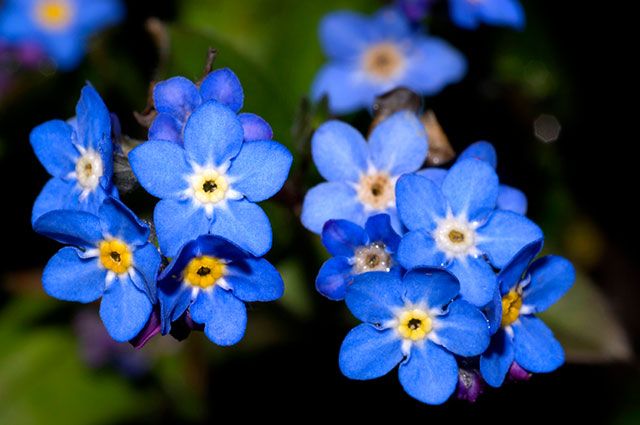
Forget-me-not. © /
www.globallookpress.com
Knowsbiologist, agronomist Mikhail Vorobyov:
Forget-me-not
Forget-me-not (Myosotis alpestris). biennial plant. Several dozen varieties are clear, among which there are varieties with snow-white and pink flowers. Seeds are sown in mid-summer, and in the fall or spring the seedlings are planted in a permanent place. But if the soil is free of weeds, then forget-me-nots reproduce well by self-sowing. In this case, you just need to replant the young plants in the desired order..
Biennials in your garden. How to care?
Borago
borage, borage (Borago officinalis). annual. At a young age (in the cotyledon phase) the plant is consumed as microgreens, because the leaves have a delicate texture and smell pleasantly like cucumber. As they grow, the leaves and trunks become rough and covered with hairs appropriate for the borage family.. Blue star flowers are sometimes candied and used to decorate confectionery products.. Borage seeds ripen unevenly, that's why they often fall off. Thus, the plant renews itself by self-seeding without human intervention.. Next year, part of the numerous shoots that appear can be used for food., and leave others for garden decoration and seed formation.
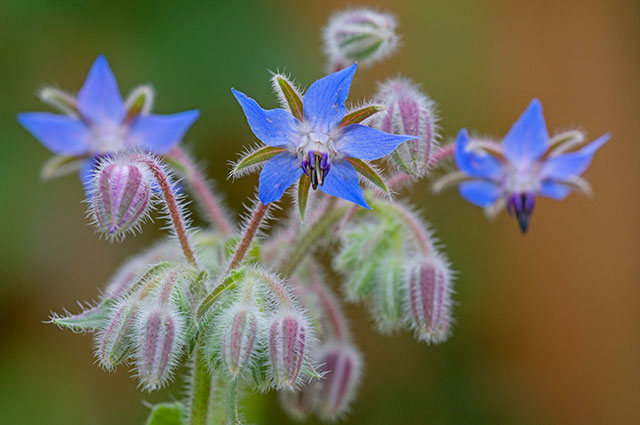
Photo: www.globallookpress.com
Honeysuckle
Contrary to its name, it is not a particularly generous honey plant.. Despite the fact that it blooms in early spring and is one of the first, naturally, attracts insects. In the forests you can usually meet the obscure lungwort (Obscure pulmonary), it grows well in the garden too, but decorators usually use other types— pharmaceutical lungwort (Pulmonaria officinalis), Lungwort angustifolia (Pulmonaria angustifolia), sweet lungwort (Pulmonaria saccharata). An interesting feature of almost all types of lungworts— variation in petal color depending on their age. Young flowers, usually, pink, but after some time the color changes to blue or bright blue. Honeysuckle— undemanding plant, grows best, being planted in light partial shade.
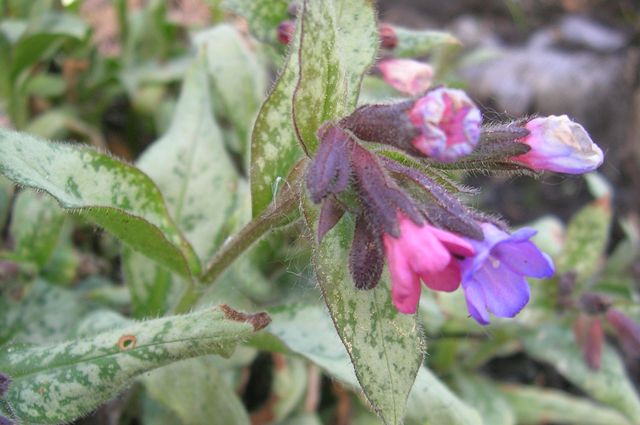
Undemanding prude. Lungwort will fit well and take root in any garden
More details
Brunner
Two types are usually grown: Brunner Siberian (Brunnеra sibirica) and Brunnera macrophylla (Brunnеra macrophуlla). Because of the matching shape and color of its flowers, Brunnera is often called a perennial forget-me-not.. However, the difference between plants is significant. Brunnera has a massive underground rhizome, which is growing actively, and other times just aggressively, crowding out other ornamental plants. Breeders are working more often with Brunnera macrophylla. Varieties with white-green leaf colors have been developed, благодаря чему растения остаются декоративными на протяжении всего периода вегетации.

Photo: From personal archive/ Misha Vorobyov
Окопник
Отношение к окопнику (Symphytum asperrimum) двойственное: On the one side, a typical long-term weed with burdock leaves and spreading flower stalks, on the other hand— owner of the purest sky blue color of flowers. That is why some carelessness of forms can be forgiven for comfrey. Comfrey behaves like a weed, it does not require special care. Unless you need to regularly limit its growth and remove flower stalks that have lost their decorative effect.
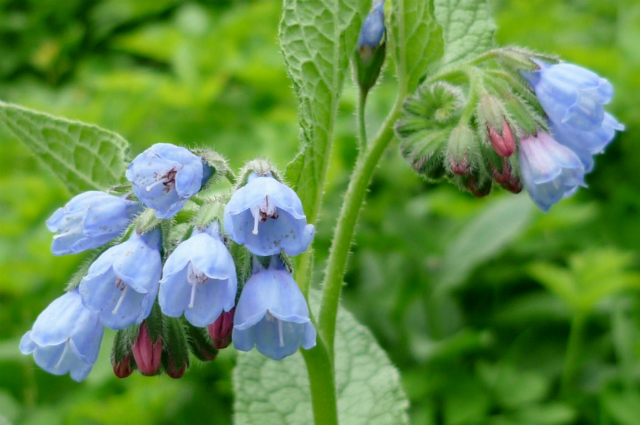
Окопник. Photo: From personal archive/ Misha Vorobiev