When they say the word "liana", then the imagination draws a tropical forest. However, beans, field bindweed and wild grapes - real vines - ideal material for vertical gardening.
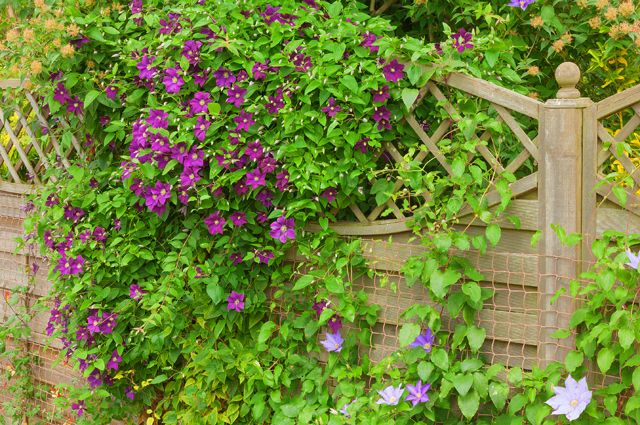
Clematis. © /
Shutterstock.com
In Russia, vertical gardening as an independent aesthetic direction has not been formed for a long time. It began to develop according to the patterns of Western fashion only in the era of six-hundred-acre summer cottages. Pergolas began to appear at dachas, wallpaper, arches, gazebos, entwined with greenery, boxettes (greenish offices)… Unfortunately, many of the vines so beloved in Europe in central Russia cannot withstand the vicissitudes of the climate.
The secret of beauty. What do ornamental trees suffer from?, bushes and vines?
Risk group
You can buy wisteria at the garden center (sometimes called wisteria). Traders will begin to insistently assure you, that this is a zoned variety, raised at a local nursery. But know, that in the next year only dry twigs may remain from your purchase. Most likely, wisteria will desperately resist, will survive one winter, may be, will survive another and even grow a little, but… will never be fun with heavy lilac tassels, what flowers bloom in Italy or France!
Cannot survive our climatic conditions and kampsis – gorgeous southern liana, blooming with large red funnel-shaped flowers with five bent petals on each. Campsis is even more thermophilic, than wisteria.
The most common plant for the Baltic states or Britain (located almost at our latitude) – ivy, enveloping the walls of houses with a thick green screen. However, in central Russia it survives exclusively as a ground cover plant.. If the ivy began to climb the wall, then cover it for the winter with a straw mat or covering material.
As for the liana-shaped strawberry, winding walls of gazebos and arches, – then this is completely a myth.
by the way
The only place in Moscow, where the unique local climate allowed ivy to cover a two-meter brick wall, - this is the Krutitsky courtyard, located on the banks of the Moscow River.
Time tested
The most common and undemanding vine – wild grapes. Correctly it is called girlish grapes, or parthenocissus. Wild grapes are growing rapidly, and in the fall it decorates the landscape with purple leaves. Easily propagated by cuttings, buried for the winter. But don't forget, that it can aggressively take over vacant areas of your site.
In central Russia, the most common maiden grape is five-leafed., despite the fact that there is also a tripointed one. It's even more decorative: smooth triangular leaves, pointed upside down, make a dense mosaic curtain, similar to dragon scales or green tiles.
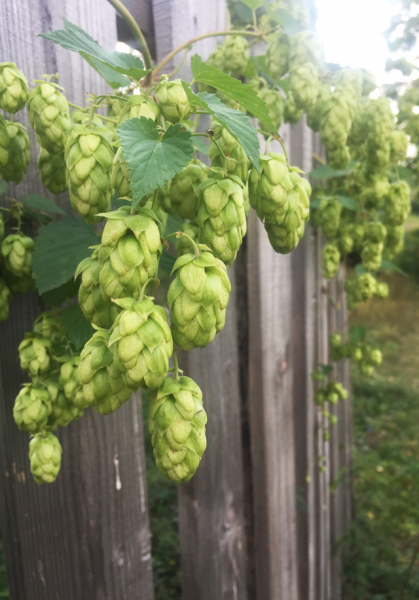
Hops. Photo: Shutterstock.com
Another favorite candidate for vertical gardening – hops. This plant is perennial, its shoots die off every autumn, but every spring new ones appear. The growth rate is fantastic – to 5 meter per season. You can dig up hops in wild nature, can you buy decorative varieties?, for example, golden form with lemon yellow leaves. by the way, The juicy tendrils and young leaves of hops are edible, and the first juicy shoots are not inferior to the tender taste of asparagus.
Bloom beautifully
Climbing roses are especially popular among gardeners.. They look great on arches and pergolas, but require winter shelter. In autumn, cut out weak shoots, leaving a few of the thickest and strongest. Remove them from the support, spray with antifungal agent, lay on the ground and cover with spruce branches or non-woven covering material. The most important – весной угадать время, когда розы пора открывать. Если это сделать слишком рано, то они имеют возможность обмёрзнуть при неожиданно сильном морозе, если поздно – намокнут и «выпреют», как молвят садоводы.
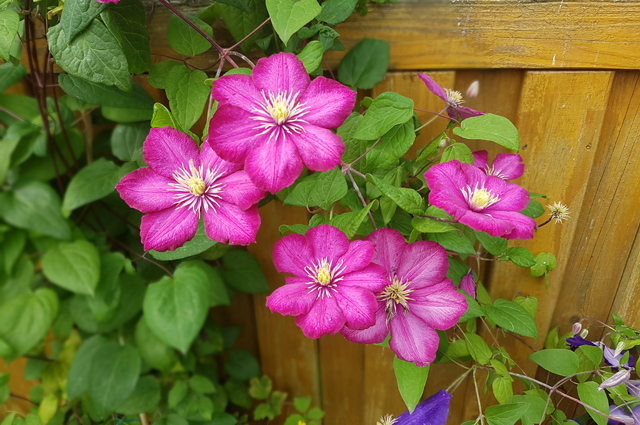
Clematis. Photo: Shutterstock.com
Не наименее нарядно, чем розы, смотрятся клематисы на опорах, шпалерах, обелисках и перголах. Их ещё именуют ломоносами, а клематисы с цветками, не раскрывающимися вполне, словно слегка поникшими, – княжиками. В продаже есть саженцы сотен видов клематисов с цветками самой разной величины, формы и цвета. Имеются сорта с большими цветками, величиной с чайное блюдце, а есть мелкоцветковые клематисы, которые покрывают опору ароматным белоснежным кружевом. Агротехника сортов различна. У одних нужно срезать побеги осенью, у других – оставлять на зиму, у третьих – срезать, но только на определённом расстоянии от земли.
Другая красивая кандидатура для вертикального озеленения, по совместительству выполняющая роль живого ароматизатора воздуха, – этрусская жимолость, либо каприфоль. Чаще встречаются белоцветковые сорта, но можно отыскать очень необычные сорта с разноцветными соцветиями. Жимолость стремительно растёт, дружно и долго цветёт и очень неприхотлива в уходе.
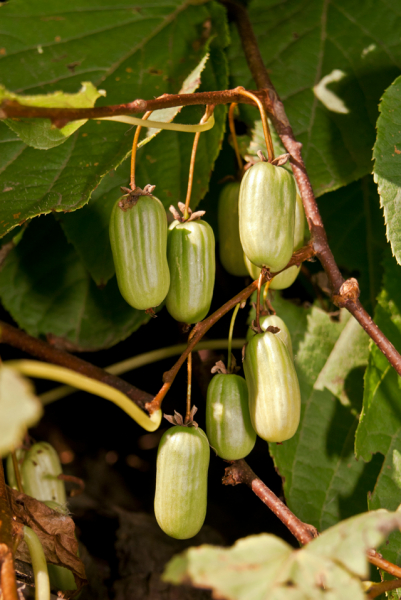
Актинидия. Photo: Shutterstock.com
Смачные лианы
Классическими лианами являются некие традиционные сельскохозяйственные культуры – виноград и фасоль. На вертикальной опоре выращивают некие сорта тыкв. При этом тяжелые плоды подвешиваются на сеточках либо устанавливаются на незаметных опорах.
Сейчас незаслуженно потеряли популярность дальневосточные плодовые лианы: актинидия и лимонник. by the way, всем известные «ягоды» киви, которые мы покупаем в магазине, не что другое, как плоды более южного вида – актинидии китайской. У нас отлично себя чувствуют два дальневосточных вида: актинидия коломикта и актинидия аргута.
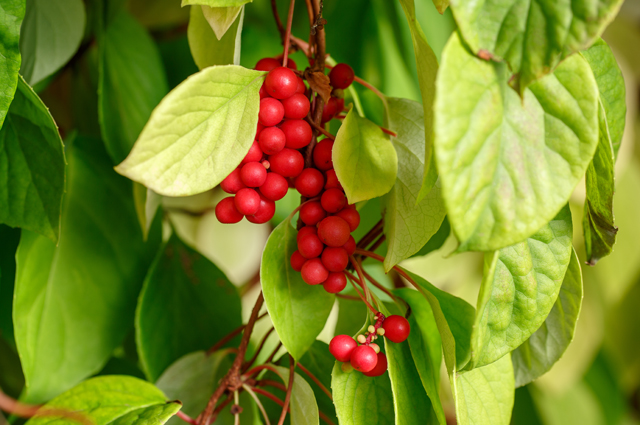
Лимонник. Photo: Shutterstock.com
Следует учесть, что актинидии – двудомные растения, потому рядом с несколькими женскими саженцами должен быть несмотря на то что бы один мужской. Плоды у наших «восточных кишмишей», naturally, не такие большие, как у их китайской сестры, но по вкусу и полезным свойствам ей не уступают.
А вот что касается полезности, то тут явный лидер другая дальневосточная лиана – лимонник. Он стремительно разрастается, creates a beautiful thick screen. In autumn, heavy clusters of bright red berries stand out beautifully among the greenery.. Лимонник – unsurpassed biostimulant. Just a couple of spoons of berries, grated with sugar, have such a massive tonic effect, that coffee and tea will seem only slightly invigorating drinks.