Turns out, some perennials, which we admire in the warm regions of our country, you can even grow there, where the frost crackles in winter and the snow lies. Naturally, you'll have to work hard for this, but the end result is worth it.
1. Blood
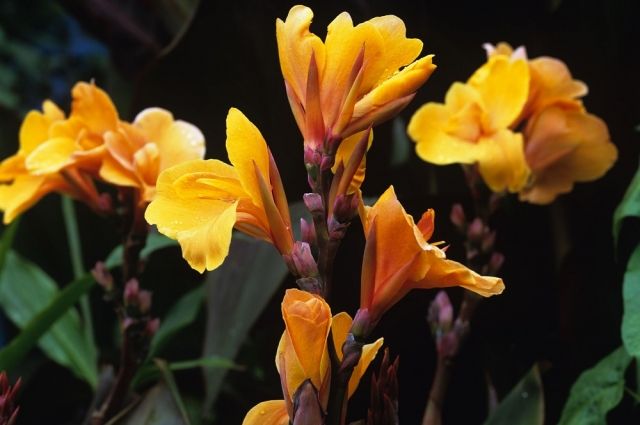
Reader Experience: how to preserve cannes in winter
More details
«Pick up the key» these regal beauties with huge leaves and bright flowers are not difficult at all: their agricultural technology is not much different from dahlias. In the middle zone, cannas do not have the opportunity to winter in open ground, so in the fall, after the first frost, the above-ground part of the plants is pruned, leaving the stump in 5-7 cm, and the rhizomes are dug up, washed, dried and stored in a cool place until spring. To ensure that cannas bloom as early as possible, they are sprouted at home and planted in the ground with sprouts after, How will the threat of return frosts pass?. They need full sun in the garden., place protected from the wind, constant watering and fertilizing.
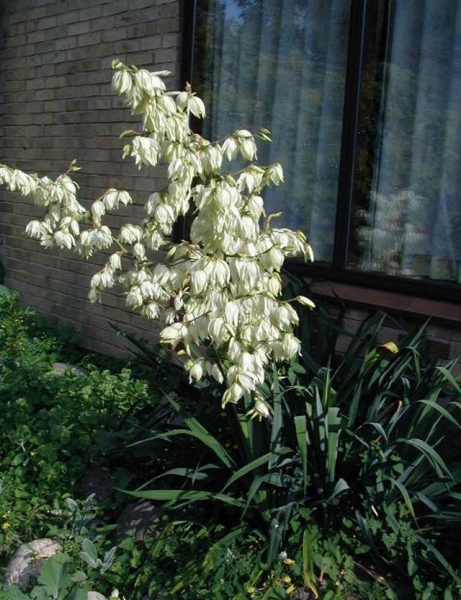
Yukka nitchataya. Photo: Commons.wikimedia.org/ Sten
2. Yukka nitchataya
This plant from the Asparagus family is remarkable for its gorgeous flowering. From the center of the outlet, which is formed by countless narrow gray-green leaves, a powerful peduncle rises up to 2 m, crowned with a panicle of large white bell-shaped flowers. The secret to successfully growing yucca in the middle zone is, basically, in the correct choice of planting site and preparation of the substrate. The plant needs a warm, sunny place without the slightest stagnation of water.. It is best to plant yucca on a slope, facing south: then she will get plenty of warmth, and moisture will not stagnate in the root zone. It needs light, permeable soil without excess organic matter and mandatory drainage.. For the winter, it is better to construct an air-dry shelter for yucca. Although the plant itself, how mind-blowing, can survive the winter without it, but flower buds will die in severe frosts. Yucca does not actually need watering, and it is necessary to feed it no more often, than once every 2-3 of the year.
3. Prickly pear
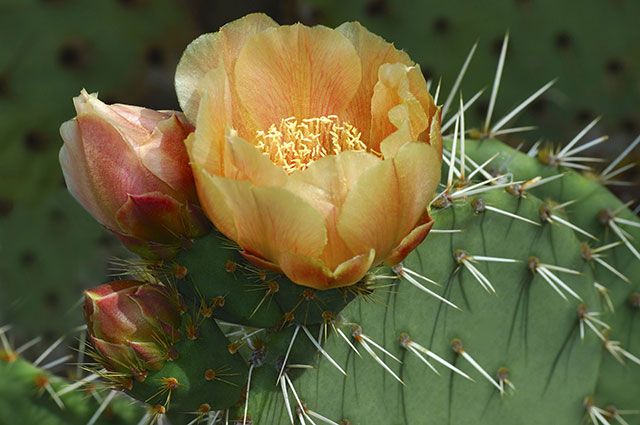
Prickly without delusion. Which cacti should not be kept at home??
More details
Cactus, growing in the garden of central Russia — not newspaper at all «fire». Representatives of the Opuntia genus are truly capable of surviving in completely, it would seem, unsuitable for their conditions. These cacti with stems, consisting of flat round pieces, studded with needles, very familiar to many lovers of indoor floriculture. The success of growing them in the garden is based on 3 pillars: maximum heat and sun in summer, minimum water in winter and sand-based soil mixed with expanded clay and gravel (as for all succulents). Prickly pear tolerates frosts stoically, but getting soaked is fatal for her, Therefore, you need to plant a cactus in such a place, where water never accumulates — eg, at the very top of the hill or on a slope with good drainage (at the same time we will avoid accidental contact of people with this plant and painful damage from small thorns). Shelter for the winter of prickly pear is not required. After wintering it usually looks deplorable, but that's no reason to be scared: the plant recovers quite quickly. Cacti growing in the garden do not need watering or fertilizing.